Evolution of a Scripting Language Into a Massive Ecosystem

JavaScript started in the mid-1990s as a small scripting language designed to add simple interactivity to web pages in the browser. It was created at Netscape Communications during the early browser wars, when websites were mostly static HTML documents with input fields and a little bit of animation (remember blinking text?)
Form Validation of Input Data
At the time, JavaScript was mostly used for form validation of input data and was considered a lightweight “toy language” compared to languages like Java or C++. As a scripting language, it didn’t need compiling and was easily rendered in the browser. Most developers did not expect it to become one of the dominant programming languages in the world.
What changed was the web itself.
From Browser Scripting Tool to Foundation of Modern Web Applications
As websites became more interactive, JavaScript evolved from a simple browser scripting tool into the foundation of modern web applications. The introduction of AJAX in the 2000s allowed web pages to update data dynamically without refreshing the page, which was revolutionary at the time, and made applications like Gmail and Google Maps possible. That shift transformed the browser into a real application platform instead of just a document viewer.
Then the ecosystem exploded.
The release of Node.js allowed JavaScript to run on servers, not just browsers. Suddenly, developers could use the same language for front-end and back-end development. This dramatically increased adoption and helped create an enormous open-source ecosystem around JavaScript tooling, frameworks, and libraries.
Modern JavaScript development now includes:
- Front-end frameworks like React, Vue, Angular, and Svelte
- Back-end development with Node.js and Express
- Mobile app development with React Native
- Desktop applications with Electron
- Cloud and serverless development
- Build tools like Webpack, Vite, Babel, and Rollup
- Massive package ecosystems through npm
- Type systems like TypeScript
- Testing frameworks, CI/CD tooling, linting, formatting, and bundling systems
Today, JavaScript is less like a single language and more like an entire platform and ecosystem. A modern JavaScript developer often spends as much time working with frameworks, tooling, configuration files, package managers, and deployment pipelines as they do writing the language itself.
From Dynamically Typed to TypeScript
One of the clearest examples of this evolution is TypeScript. Originally, JavaScript was dynamically typed and relatively loose in structure (as opposed to other languages such as Java, which was “strongly typed”, meaning it enforces data type rules). As applications became larger and more complex, developers wanted better maintainability and tooling. TypeScript added optional static typing, stronger IDE support, and enterprise-scale development features on top of JavaScript. Many large companies now use TypeScript as their default way to write JavaScript applications.
The ecosystem also changes extremely quickly. Frameworks rise and fall in popularity within just a few years. Best practices constantly shift. New tooling replaces old tooling at a rapid pace. A JavaScript developer from 2010 would barely recognize the modern development stack used today.
How the JavaScript Front-end landscape has changed over the past 10 years:
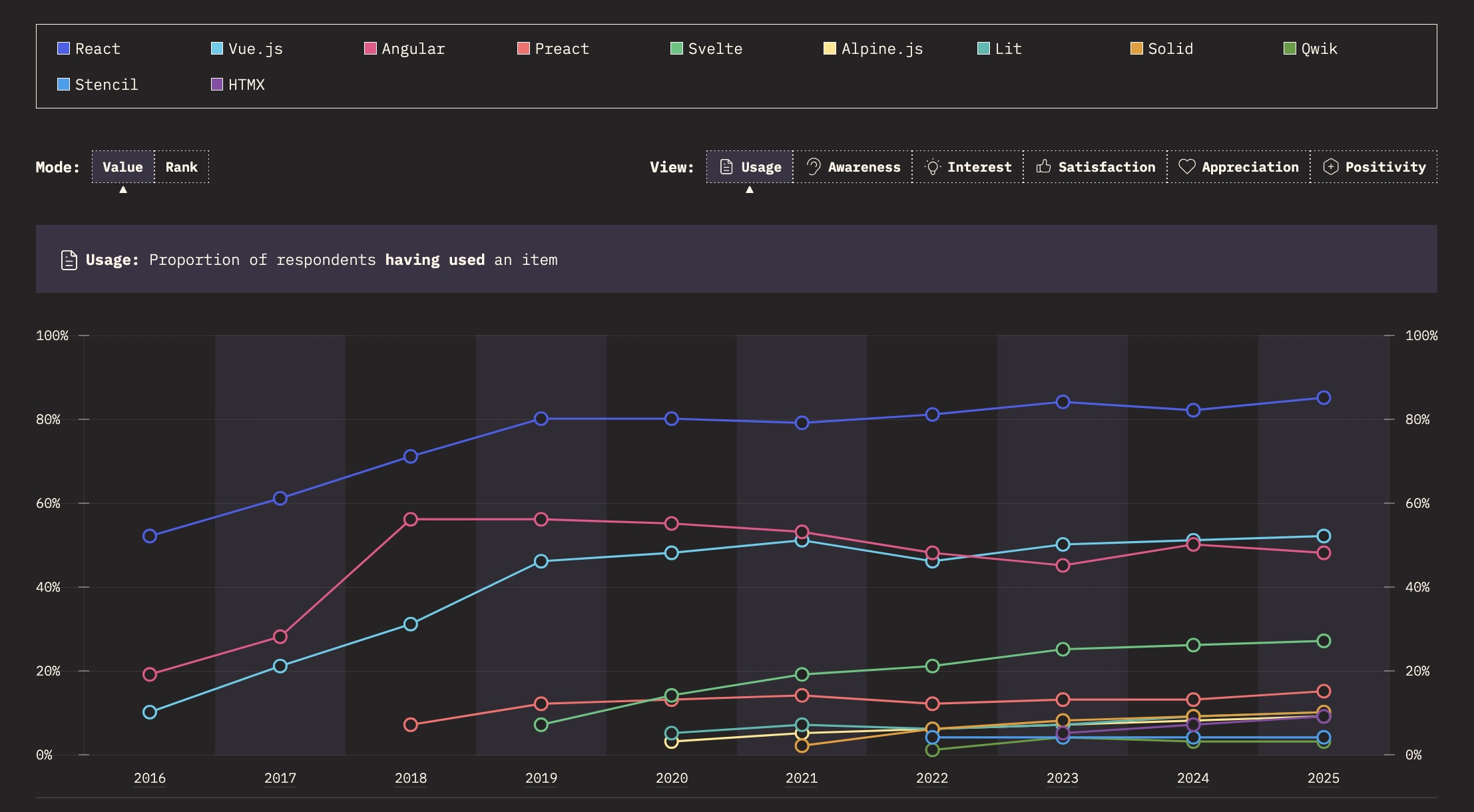
Source: State of JavaScript 2025 https://2025.stateofjs.com/en-US/libraries/front-end-frameworks#front_end_frameworks_ratios